
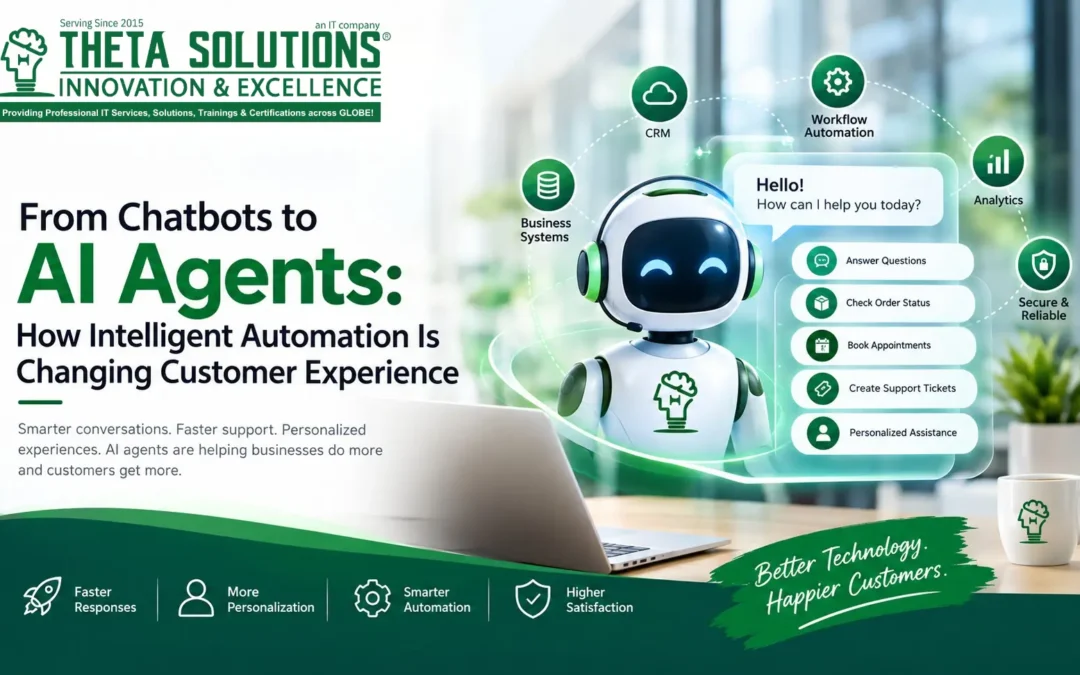
Customer expectations have changed dramatically. People want quick answers, helpful conversations, personalized support, and service that feels available whenever they need it. A chatbot can answer common questions, but modern businesses increasingly need technology that can understand context, use business systems, and complete tasks.
This is where AI agents are becoming important.
For businesses, this evolution can improve response times, reduce repetitive work, and create more consistent customer journeys. For customers, it can mean getting the right help without explaining the same problem several times.
What Is AI Automation?
AI automation combines artificial intelligence with automated workflows so systems can understand information, make decisions, and carry out routine actions with limited human involvement.

Traditional automation usually follows predefined rules. If a customer submits a form, for example, the system may send an email and create a ticket. AI automation can go further by interpreting the customer message, identifying intent, checking relevant information, deciding what should happen next, and triggering the appropriate workflow.
An AI automation bot can therefore become more than a question-and-answer tool. When connected to business systems, it can help with:
- Answering frequently asked questions
- Checking order or appointment information
- Collecting customer details
- Creating or updating support tickets
- Routing conversations to the right team
- Summarizing customer interactions
- Sending follow-up messages
From Chatbots to Agentic AI
A traditional chatbot generally works within a defined conversation structure. Modern AI chatbots can be more flexible because they use large language models to understand natural language and generate responses.
AI agents introduce another layer of capability. An agent can reason about a task, use available tools, remember relevant context, and take actions toward a defined goal. Google Cloud describes AI agents as systems that pursue goals and complete tasks on behalf of users, with capabilities such as reasoning, planning, memory, and autonomy. IBM similarly explains that agents can design workflows, interact with external environments, and perform tasks using available tools.
Imagine a customer saying, “My order has not arrived. Please check what happened and tell me when I should expect it.”
A basic chatbot may provide a tracking page.
An AI agent could understand the request, identify the order, check the delivery system, review the latest status, provide an explanation, and escalate the issue if something requires human attention.
That difference is at the heart of the move toward agentic AI.
AI Agent Types Businesses Should Know
AI agents can be designed for different purposes. There is no single model that fits every organization.
Common AI agent types include:
- Customer service agents, which answer questions, troubleshoot common issues, and guide customers through support processes.
- Task-based agents, which complete actions such as booking appointments, updating records, or processing routine requests.
- Knowledge agents, which search approved company information and help customers or employees find relevant answers.
- Sales agents, which qualify leads, answer product questions, recommend suitable options, and support follow-up activities.
- Workflow agents, which coordinate multiple steps across applications and business systems.
- Voice agents, which communicate with customers through natural spoken conversations.
- Multi-agent systems, where several specialized agents collaborate on a larger process.
The right approach depends on the business goal, available data, customer expectations, and level of automation that makes sense for the organization.
AI Agent Examples in Customer Experience
AI agent examples are already appearing across industries.
An online store can use an agent to answer product questions, check inventory, track an order, and guide a customer through a return request.
A healthcare organization can use an agent for appointment information and basic administrative questions while sensitive decisions remain under professional supervision.
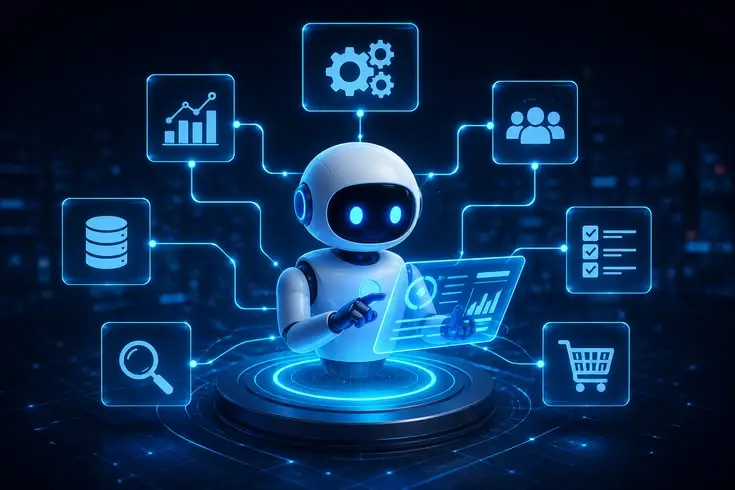
A financial service provider can use agents to explain routine account processes, collect information, and route complex cases to trained staff.
A travel company can use an agent to understand preferences, compare available options, and assist with booking-related tasks.
These examples show an important principle. A strong customer experience does not come from automation alone. It comes from connecting intelligence with useful business actions.
Why AI Agents Are Changing Customer Experience
The biggest change is the move from reactive support to more contextual service. Customers do not want to search through several pages just to find a simple answer. They expect businesses to understand what they need and help them reach a solution quickly.
1. Faster Responses
An AI agent can respond immediately to routine questions, even outside normal business hours. This reduces waiting time and creates a convenient first point of contact.
2. More Personalized Interactions
When an agent can securely access relevant customer information, it can provide more contextual responses instead of asking customers to repeat details.
3. Better Self-Service
Customers can solve many straightforward issues without waiting for a representative. Microsoft highlights AI-based self-service across chat, voice, and other interfaces as a way to provide faster support and improve resolution.
4. Smarter Escalation
Automation should not mean removing people from customer service. A well-designed system knows when a conversation is too complex, sensitive, or unusual and transfers it to a human representative with useful context. Google Cloud describes virtual agents that can hand conversations to human agents when they reach knowledge limits or encounter technical issues.
5. Consistent Service
AI agents can follow approved business policies and access centralized knowledge, helping organizations provide more consistent information across customer interactions.
What Are AI Voice Agents?
AI voice agents are intelligent systems that communicate with people through spoken conversation. Instead of typing into a chat window, customers can speak naturally and receive spoken responses.
So, what are AI voice agents? In simple terms, they are conversational AI systems designed to listen, understand, respond, and perform relevant actions during a voice interaction.

Modern voice agents can support:
- Answering incoming customer calls
- Scheduling appointments
- Checking order information
- Collecting basic customer details
- Routing calls
- Providing account-related information
- Transferring complex conversations to human representatives
Microsoft and Google Cloud are both developing voice-based customer service experiences that can understand caller intent and connect customers with appropriate support when needed.
AI Voice Agent Platform and Business Integration
A useful voice solution needs more than natural-sounding speech. It should connect with the systems that a business already uses.
For example, imagine a customer calls a service company and says they need to change an appointment. A connected voice agent can identify the request, verify the relevant information, check available times, update the appointment, and confirm the result.
This creates a smoother experience because the customer does not have to move between different channels or repeat information.
An effective AI voice agent platform should therefore support reliable integrations with customer relationship management systems, help desks, appointment tools, databases, communication channels, and internal knowledge sources.
Best AI Voice Agents: What Should Businesses Look For?
When comparing the best AI voice agents, businesses should focus on practical performance rather than impressive demonstrations.
Important considerations include:
- Natural conversation quality
- Accurate intent recognition
- Low response delay
- Ability to handle interruptions
- Secure access to business information
- Integration with existing systems
- Human escalation
- Conversation monitoring
- Analytics and reporting
- Privacy and data protection
- Support for relevant languages and accents
- Clear controls over what the agent is allowed to do
A good voice agent should make customer interactions easier and more convenient while keeping human support available for situations that require judgment.
What Are the Best AI Workflow Automation Tools?
There is no universal answer to what are the best AI workflow automation tools because the right choice depends on the workflow, technology environment, budget, data requirements, and desired level of control.
Businesses may evaluate platforms that combine AI agents with workflow automation, CRM integration, customer service systems, communication tools, and analytics.
Before selecting a tool, ask:
- What problem are we trying to solve?
- Which tasks should be automated?
- What systems need to be connected?
- What information can the AI access?
- When should a human take over?
- How will performance be measured?
- How will privacy and security be maintained?
The best tool is usually the one that fits the business process rather than the one with the longest feature list.
The Human Role Still Matters
One of the biggest misconceptions about AI agents is that intelligent automation means replacing every human interaction.
In reality, customer experience often improves when AI and people work together.
AI can handle repetitive questions, gather information, summarize conversations, and complete routine tasks. Human employees can focus on complex cases, emotional situations, negotiation, relationship building, and decisions that require professional judgment.
This approach allows customer service teams to spend more time on conversations where human understanding makes the greatest difference.
Building Trust Into AI Automation
Trust should be considered from the beginning of an AI project. Businesses should define what an agent can access, what actions it can perform, and when it must ask for human approval.
They should also monitor accuracy, review conversations, protect customer information, and create clear escalation procedures. Microsoft emphasizes evaluating agent capabilities, limitations, data use, and operational controls as part of responsible deployment.
Businesses should also establish clear performance measurements. Response time, resolution rate, customer satisfaction, escalation rate, repeat contact rate, and task completion accuracy can help teams understand whether an AI solution is actually improving customer experience.
How Businesses Can Prepare for the Agentic Future
A practical approach starts with a specific customer problem.
Begin by identifying repetitive interactions that consume employee time but follow a clear process. Next, organize the knowledge the AI will need and connect only the systems required for the selected workflow.
Then test the agent with real world scenarios, including unusual questions and failed attempts. Keep human escalation available during early stages and continuously review performance.
A strong implementation can follow this path:
- Identify a clear customer problem
- Map the existing workflow
- Select the right AI approach
- Connect trusted business data
- Define permissions and limits
- Test realistic conversations
- Introduce human escalation
- Measure results and improve
This gradual approach helps businesses control risk while learning where AI can deliver the most value.
The Future of Customer Experience Is Intelligent and Human
The journey from chatbots to AI agents represents a meaningful change in how businesses can serve customers. Chatbots made digital conversations faster. AI agents are taking the next step by connecting conversation with reasoning, workflow execution, and business systems.
Agentic AI can help companies move from simply answering customers to actively helping them reach an outcome.
For organizations planning this transition, technology should never be the starting point. The customer problem should come first. Businesses need to understand where customers struggle, which processes create delays, and where intelligent automation can create genuine value.
Companies looking for the best IT company in Pakistan or an award winning IT company in Pakistan should evaluate technical expertise, security practices, integration experience, communication, and the ability to build solutions around real business requirements.
As AI agents become more capable, businesses that combine intelligent automation with human expertise will be better positioned to deliver faster, more personal, and more trustworthy customer experiences.