
When you open Crawl Stats inside Google Search Console, you’ll see multiple sections:
- Total crawl requests
- Total download size (bytes)
- Average response time
- By response
- By file type
- By purpose
- By Googlebot type
Most store owners panic when they see numbers.
But a crawl budget is not about “high numbers.” It’s about efficiency + smart distribution.
1: What Is Crawl Budget
Crawl budget = How often Google visits your site + how many URLs it chooses to crawl.
For B2C websites, crawl budget matters because:
- You have product pages
- Seasonal collections
- Filters
- Images
- Faceted navigation
If Google wastes time on junk URLs, your important pages get crawled slower.
TOP SECTION EXPLAINED (Very Important)
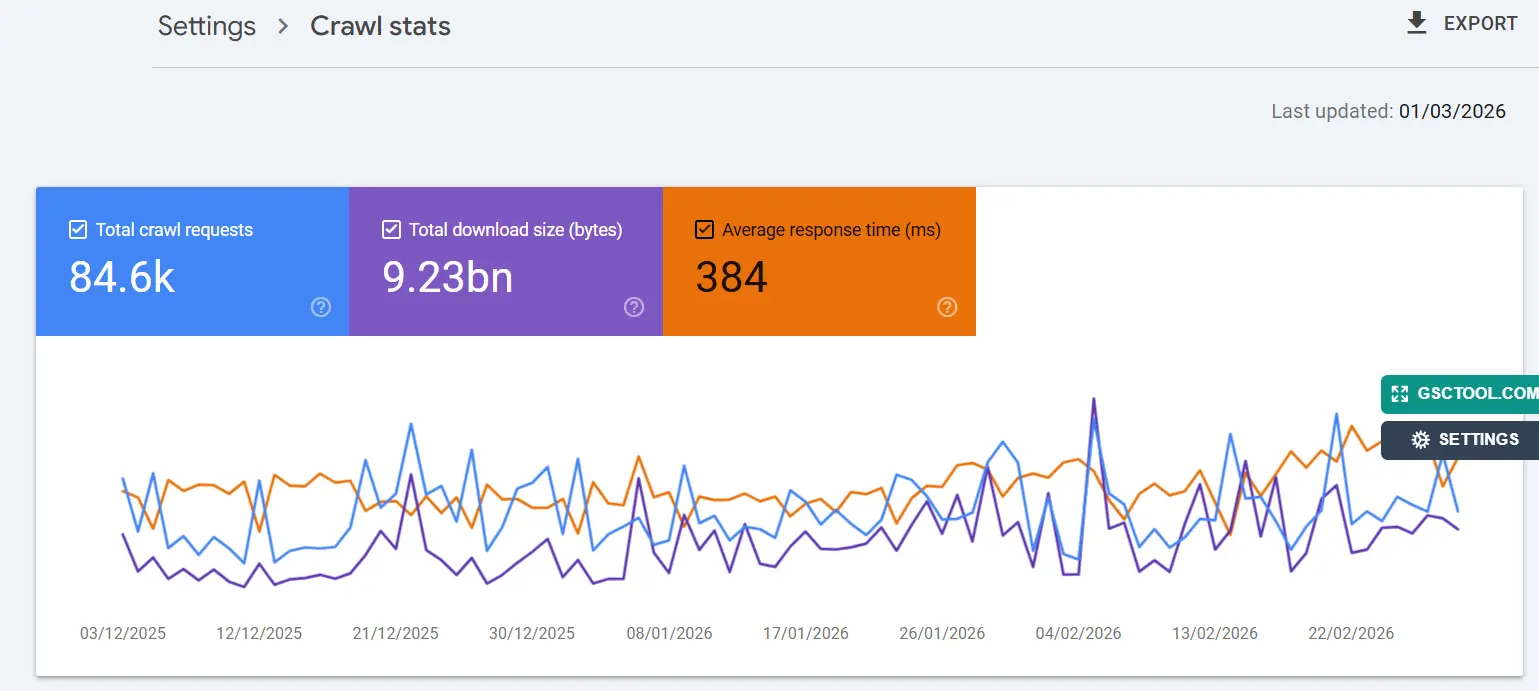
1. Total Crawl Requests
This shows:
How many URLs Google crawled per day.
Example:
- 1,000/day
- 5,000/day
- 20,000/day
What’s Ideal for B2C?
| Site Size | Ideal Crawl Requests |
| Small (Under 300 URLs) | 200–1,000/day |
| Medium (300–2,000 URLs) | 1,000–5,000/day |
| Large (2,000+ URLs) | 5,000+ |
More important than volume is consistency.
You don’t want huge spikes and drops.
2. Total Download Size (Bytes)
This shows: How much data Google downloads when crawling your site.
If this is very high:
- Pages are heavy
- Too many scripts
- Large images
For Shopify B2C stores: Ideal Range:
- Moderate and stable
- Not constantly increasing
If download size increases but HTML crawl stays same → It means resource bloat (apps, JS, tracking scripts).
3. Average Response Time
This shows: How long your server takes to respond to Googlebot.
Ideal for B2C:
| Response Time | Meaning |
| < 200ms | Excellent |
| 200-500ms | Good |
| 500-800ms | Needs improvement |
| 800ms+ | Risky |
Slow response time reduces crawl frequency.
For Shopify, you usually stay safe unless apps overload scripts.
IDEAL CRAWL RATIO FOR B2C WEBSITES
Now let’s define ideal ratios.
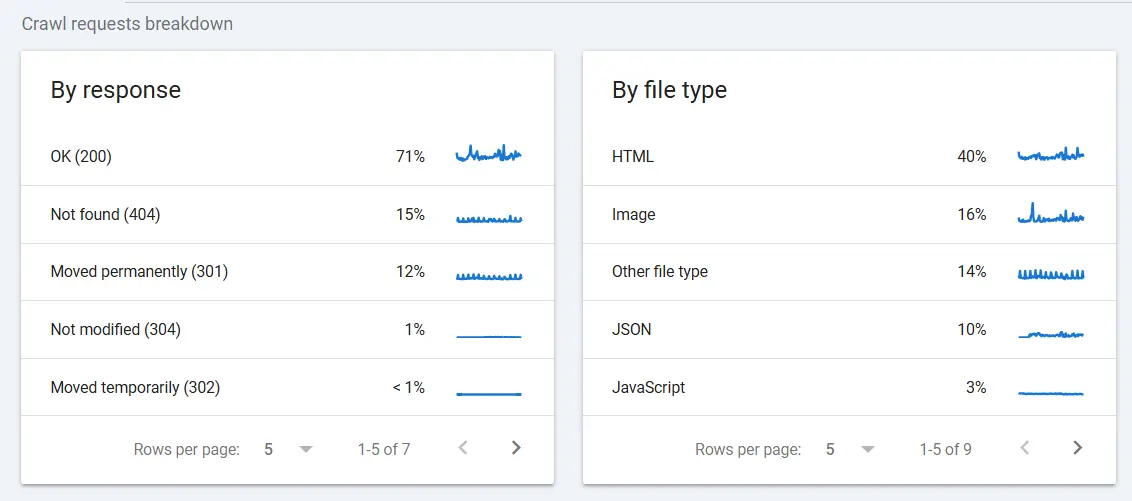
A) By Response – Ideal Distribution
| Response Type | Ideal % | Why |
| 200 OK | 80-90% | Healthy crawl efficiency |
| 301 | <10% | Normal but minimal redirects |
| 404 | <5% | Prevent crawl waste |
| 5XX | <1% | Server must stay stable |
| 302 | <1% | Avoid temporary redirects |
If 404 >10% → crawl waste
If 301 >15% → inefficient structure
B) By File Type – Ideal for B2C
| File Type | Ideal % | Why |
| HTML | 45-60% | Core money pages |
| Images | 15-25% | Product visuals important |
| JS + CSS | 10-20% combined | Necessary but controlled |
| JSON / APIs | <10% | Data calls normal |
| Unknown / Failed | <5% | Should stay minimal |
If Unknown >10% → investigate resource issues.
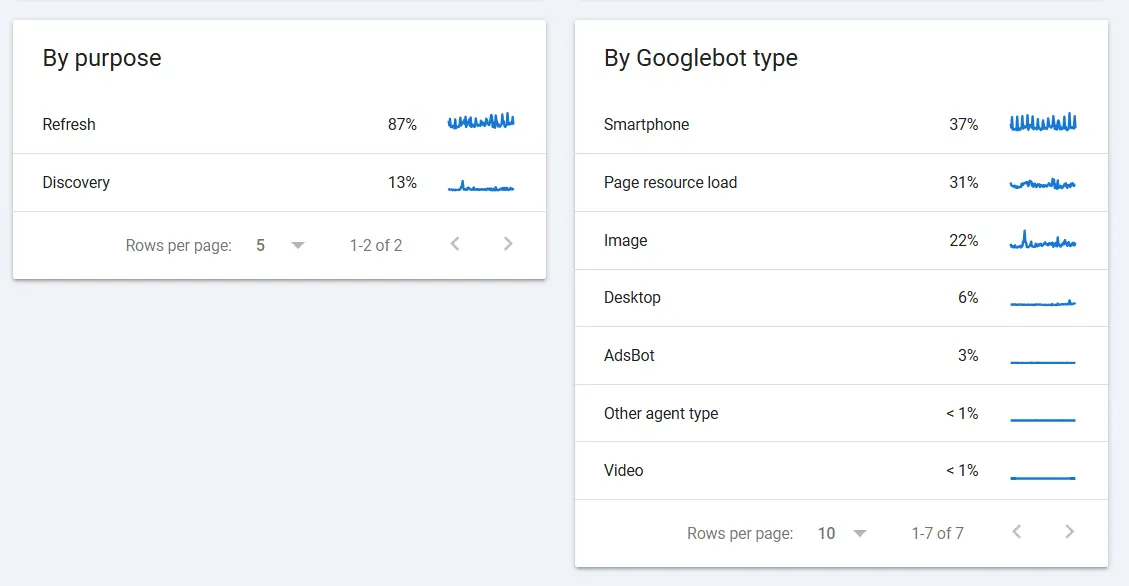
C) By Purpose – Growth Indicator
| Purpose | Ideal % | Why |
| Refresh | 60-75% | Google maintaining index |
| Discovery | 20-30% | Ranking expansion |
If Discovery <15%: You’re not expanding authority strongly.
For aggressive growth phase: Discovery should increase temporarily.
D) By Googlebot Type – Healthy Pattern
| Bot Type | Ideal Trend |
| Smartphone | Highest (Mobile-first world) |
| Page resource load | Normal for JS sites |
| Desktop | Lower than mobile |
| Image bot | Present for visual ecom |
No need to “optimize” this manually, just ensure mobile UX strong.
What Happens If Crawl Budget Is Bad?
For B2C:
- Seasonal pages index late
- New products rank slowly
- Faceted URLs consume crawl
- Old deleted products waste authority
Revenue impact becomes indirect but real.
Now Let’s Compare Ideal vs Your Situation
| Metric | Ideal | Your Site | Status |
| 200 OK | 80–90% | 71% | Needs improvement |
| 404 | <5% | 15% | Legacy waste |
| 301 | <10% | 12% | Slightly high |
| Discovery | 20–30% | 13% | Low expansion |
| Unknown | <5% | 15% | Needs cleanup |
Your Crawl Budget Grade for B2C
Current: 7.2 / 10
Ideal Target: 8.5 / 10
But important:
Crawl budget is NOT your main ranking bottleneck right now.
Your bigger growth limiter is:
- Page depth
- Keyword targeting
- Authority flow
- Competitive strength
When Should You Worry About Crawl Budget?
Only if:
- Large site (10k+ URLs)
- Massive faceted filtering
- Crawl spikes + server slowdown
- Many soft 404s
For mid-size Shopify B2C: Crawl budget matters less than content quality + authority.
Crawl budget optimization should be maintenance, not main growth strategy.
Related Articles:
The Ideal Crawl Budget for B2C eCommerce Websites in 2026